Disclosure: This guide contains affiliate links. If you purchase through our links, we may earn a small commission at no extra cost to you.
Planning an international trip can feel overwhelming — there are too many decisions, too many tabs open, and no obvious starting point. After years of international travel with my wife, I've landed on a framework that works whether you're planning a long weekend in Europe or a two-week trip across multiple countries.
The biggest lesson: the order of operations matters more than the tools you use. Lock things down in the right sequence and the rest of the planning falls into place naturally.
Step 1: Lock Down Your Flights First
Everything else in trip planning builds around your dates — accommodation availability, time off work, tours that need to be booked in advance. Flights come first.
If you're paying cash, Google Flights is the best tool for comparing prices. Use the calendar view with flexible dates to find the cheapest windows, and set a price alert so you're notified when the fare drops. Book directly with the airline when possible — third-party booking sites add complications if anything goes wrong.
If you're traveling on points and miles — which I'd strongly encourage exploring if you haven't already — award availability is the first thing I check, before I even commit to a destination. Premium cabin award seats are limited and get snapped up fast. I use point.me and seats.aero to search across multiple loyalty programs simultaneously before I commit to anything.
New to travel rewards?
The right combination of travel credit cards can cover flights and hotels that would otherwise cost thousands of dollars. I built Supapoints to help people manage their rewards cards and find the best cards for their spending — the Card Advisor tool is a good starting point if you're not sure where to begin.
Once your flights are booked, you have fixed dates. Everything else becomes significantly easier to plan.
Step 2: Choose Your Neighborhood & Accommodation
The core tradeoff in accommodation is central location versus price. Staying in the heart of a city costs more, but it saves time and transport money — in most cities, the math works out in favor of something more central, especially if you're doing a lot of sightseeing on foot.
Research the neighborhoods first, not just the hotels. In most cities, being in the right neighborhood matters more than the hotel itself.
Hotel status is one of the most underrated travel upgrades.
If you travel more than once or twice a year, getting a hotel credit card (Marriott Bonvoy, Hilton Honors, World of Hyatt) is one of the highest-leverage moves in travel. Elite status unlocks room upgrades, late checkout, and complimentary breakfast at many properties — all at zero extra cost once you have the status.
During a recent stay at the St. Regis Beijing, my Marriott Bonvoy Platinum Elite status got us upgraded from a standard king room to a one-bedroom suite for a five-night stay — plus complimentary breakfast buffet for both of us every morning. That's a meaningful upgrade at no additional cost, simply from having the right card.
Step 3: Build Your Itinerary
I build my itinerary in Apple Notes — a simple, shareable day-by-day list. Google Docs works just as well if you want something more structured or collaborative.
My rule: plan 2–3 sights or activities per day, maximum. For anything time-intensive — a full-day tour, a day trip to a nearby city, a major museum that warrants half a day — I'll plan just 1–2 things.
Why less is more
Some of the best moments from our trips haven't been planned: spending an unexpected extra hour at a small bar we genuinely loved, stumbling onto a quiet piazza in Venice with no tourists, or ending up at a local market we had no idea existed. Over-scheduled trips don't leave room for those moments — and those moments are often what you remember most.
Build the skeleton — your must-dos, your one or two big experiences per day — and leave the rest open. You'll fill it in as you go, and what you fill it in with is usually better than anything you could have planned in advance.
Step 4: Book Tours & Experiences
My wife and I book 1–2 guided tours on most international trips. A good guide brings context, stories, and access that you simply can't replicate on your own — especially in historically dense cities like Rome, Athens, Istanbul, or London. Walking through a 900-year-old building with someone who can explain the politics, the people, and the meaning of what you're looking at is a completely different experience from reading a placard.
I typically book on Viator, which has the widest selection and a reliable review system. GetYourGuide is a strong alternative with similar coverage.
Step 5: Sort Out Your Airport Transfer
Private airport transfers are underrated — particularly at the start of a trip after a long-haul flight. After 12–15 hours in the air, the last thing you want to do is drag three or four bags through a packed subway car or navigate an unfamiliar train system half-asleep.
A private car from the airport to your hotel removes all of that friction. You walk out of arrivals, someone is holding a sign with your name, and you're at the hotel in 30–45 minutes without any decisions to make. It's a small thing that makes a meaningful difference at the start of a trip.
In many destinations — Thailand, Vietnam, Japan, much of Southeast Asia — private transfers are extremely affordable compared to Western pricing. Viator, Klook, and Blacklane all offer private airport transfers in most major cities. It's worth the cost.
Step 6: Rent a Car If You Need One
If you're exploring beyond major cities — rural Italy, the Scottish Highlands, Iceland's Ring Road, coastal Portugal — a rental car is often the only practical option. Public transport doesn't reach most of the best places.
Book as early as possible for the best rates. Prices rise significantly closer to the travel date, especially in popular summer destinations. Always compare across multiple rental companies — rates for the same car at the same location can vary dramatically.
Car Rental
Compare Car Rental Rates on DiscoverCars
Search 500+ rental companies worldwide. Free cancellation on most bookings.
Step 7: Sort Out Your Data Plan
Having mobile data abroad is non-negotiable. You need it for navigation (Google Maps), translation, restaurant research, checking transport schedules, and staying in touch. A trip without data is a trip where you're constantly hunting for WiFi.
International roaming from US carriers typically runs $10–12/day — that's $70–84 on a week-long trip. A travel eSIM covers the same destination for a fraction of the cost and can be installed before you leave home. 5 GB for a week starts around $3.50–$9 across most of Europe and Asia.
Compare eSIM Plans for Your Destination
We've compared plans from Airalo, Holafly, Saily, and 10+ other providers. Find the best data plan for your trip before you leave home.
Compare eSIM PlansStep 8: Get Travel Insurance
Travel insurance is the one thing most people skip and then regret when something goes wrong. A medical emergency abroad can be extraordinarily expensive without coverage. Trip cancellations, delayed luggage, and missed connections are all covered under most comprehensive policies.
The question isn't whether something will eventually go wrong — it's whether you're comfortable absorbing the full cost if it does. For most international trips, a solid policy costs less than a single night's accommodation.
Travel Insurance
Get Covered with SafetyWing
Comprehensive travel medical insurance. Coverage starts from around $1.50/day.
Step 9: Pack
Packing is the last thing to sort — not the first. Too many people start here and end up stressed about gear before they've even booked a flight.
The general principle: pack less than you think you need. Most destinations have laundry options, and most things you forget can be bought locally. The cost of over-packing is carrying heavy bags through airports and up hotel stairs for the duration of your trip.
Day-of Checklist
- 1Check in online (24–48 hours before departure) and download your boarding pass
- 2Enable your travel eSIM or confirm data roaming settings
- 3Download offline maps for your destination (Google Maps → Download area)
- 4Confirm accommodation address and check-in time
- 5Confirm airport transfer booking if applicable
- 6Pack your travel documents: passport, visa (if required), travel insurance card
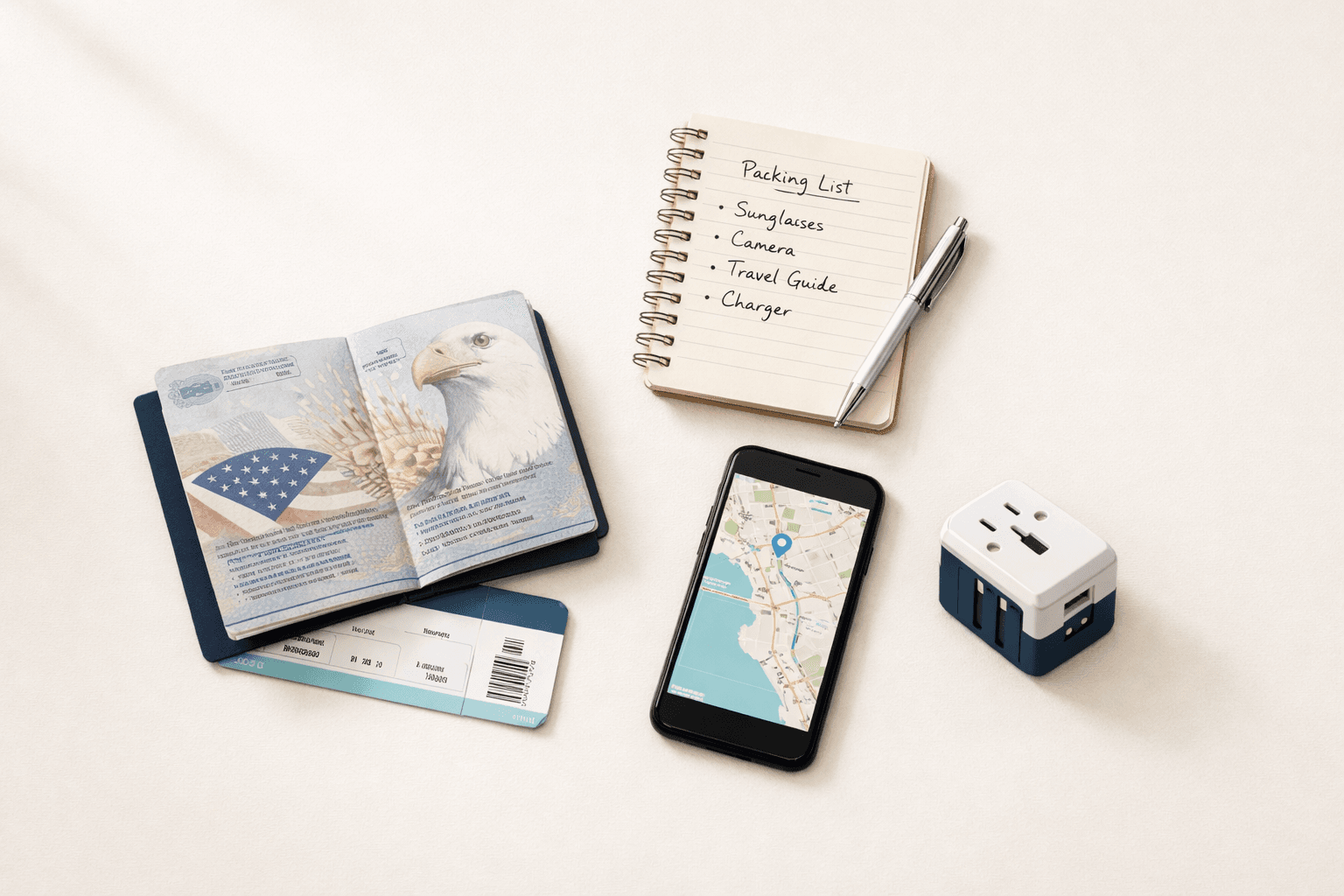
- 7Charge all devices and pack charger, adapter, and power bank
- 8Notify your bank of international travel to avoid card blocks
- 9Set up Google Translate with your destination language for offline use
- 10Check the weather forecast and pack or adjust accordingly
Frequently Asked Questions
▶How far in advance should you plan an international trip?
For most international trips, 3–6 months gives you the best combination of flight availability and pricing. If you're traveling during peak season (summer in Europe, cherry blossom season in Japan, Christmas/New Year's) or planning to use points and miles for premium cabin awards, 6–12 months out is more realistic. For shorter-haul trips or shoulder season travel, 6–8 weeks can work fine.
▶What should I do first when planning an international trip?
Lock down your flights first — everything else builds around your dates. If you're paying cash, set price alerts on Google Flights and compare across a few weeks of flexibility. If you're using points and miles, check award availability first before committing to a destination, since premium award seats are limited. Once flights are booked, you have fixed dates to plan accommodation and activities around.
▶How do you plan an itinerary without over-scheduling?
Cap yourself at 2–3 sights or activities per day — 1–2 for anything time-intensive like a full-day tour or day trip. Build your rough daily plan in Apple Notes or Google Docs, but leave blocks of unscheduled time. Some of the best travel memories come from spending an extra hour somewhere you loved, getting genuinely lost in a neighborhood, or stumbling into a market you had no idea existed. Over-scheduled trips don't leave room for those moments.
▶Is travel insurance worth it for international trips?
Yes — especially for international travel. The main scenarios where it pays off: medical emergencies abroad (which can be extremely expensive without coverage), trip cancellations due to illness or emergencies, and lost or delayed luggage. The question isn't whether something will go wrong eventually; it's whether you're comfortable absorbing the cost if it does. For most travelers, a comprehensive policy costs less than a single night's accommodation.
▶Do I need a travel eSIM for every international trip?
For any international trip where you'll rely on navigation, translation, or communication, yes. Your home carrier's international roaming typically runs $10–12/day — that's $70–84 on a week-long trip. A travel eSIM for the same destination costs a fraction of that and can be installed before you leave home. The only exception is if your carrier offers free international data on your plan (some T-Mobile and Google Fi plans include it).
▶What's the best tool for searching award flight availability?
point.me and seats.aero are the two most useful tools for searching award availability across multiple loyalty programs simultaneously. They let you find where your points are most valuable before you decide on a destination or book anything. Google Flights is the best tool for cash tickets — use the calendar view with flexible dates to find the cheapest windows.