Disclosure: This guide contains affiliate links. If you purchase through our links, we may earn a small commission at no extra cost to you.
Dublin is one of Europe's most compact and walkable capitals — a city you can cover on foot, with a thousand years of history packed into a centre barely two miles across. Viking ruins sit beside Georgian squares, medieval cathedrals beside independent bookshops, and on every other corner there's a pub that's been pulling pints for two centuries.
My wife and I visited Dublin at the end of August 2026, on our way to London. This guide grew out of the research we did before that trip: what to book in advance, what's worth the ticket price, and where the locals quietly tell you to go instead. We're adding firsthand notes and photos from the visit.
This guide focuses on the unmissable experiences, the day trips worth the extra time, the practical information you need to navigate the city without overspending, and how to stay connected without paying $12/day for roaming.
1. The Guinness Storehouse
The most-visited tourist attraction in Ireland, and despite being aggressively commercial, it's genuinely worth the visit. Seven floors inside the original 1904 fermentation plant at St. James's Gate, the building is shaped like a giant pint glass — the central atrium would hold 14.3 million pints of Guinness.
What you'll see:
- Floor 1: the 9,000-year lease Arthur Guinness signed in 1759 for £45 a year, embedded in the floor under glass.
- Floors 2–4: brewing process, ingredients (water, barley, hops, yeast), and the company's advertising history, including the famous toucan ads.
- Floor 5: 'Guinness Academy' where you learn to pour the perfect pint and get a certificate.
- Floor 7: the Gravity Bar, a 360° glass-walled room with panoramic views over Dublin. Your ticket includes a complimentary pint here.
- On-site restaurants and a brewery shop with rare merch you won't find elsewhere.
Tip: Book the timed-entry ticket online — around €30 for standard adult entry, more for the "Connoisseur Experience" with a tasting. The Storehouse gets crowded between 11 AM and 3 PM. Book the earliest or latest slot to enjoy the Gravity Bar without elbow-fighting for window space. Plan 2–3 hours.
2. Trinity College & the Book of Kells
Founded in 1592 by Queen Elizabeth I, Trinity is Ireland's oldest university and one of the most beautiful campuses in Europe. The cobbled main square, Parliament Square, looks largely as it did in the 18th century.
The headline attraction is the Book of Kells, a 9th-century illuminated manuscript of the four Gospels in Latin — one of the finest examples of medieval Western art anywhere in the world. It lives in the Old Library and is kept open to two pages at a time, rotated every few months.
What you get with the ticket:
- The Book of Kells exhibition explaining the manuscript's history, the monastery at Kells, and the craft of illumination.
- Two pages of the Book of Kells itself, displayed under glass.
- The Long Room: a 65-meter barrel-vaulted library lined with 200,000 of Trinity's oldest books and marble busts of philosophers. It's the room Star Wars fans recognize as the inspiration for the Jedi Archive.
- Brian Boru's harp — one of the oldest surviving Gaelic harps and the model for the Irish coat of arms (and the Guinness logo).
Tip: The Long Room underwent major conservation work in 2023–24 and many shelves were temporarily empty during the restoration. Check the current status before booking. Tickets are around €19 online; walk the rest of the campus for free. The student-led guided tours of Trinity itself are excellent and start at the front gate.
3. Kilmainham Gaol
If you visit one site in Dublin to understand modern Irish history, make it this one. Kilmainham Gaol held the leaders of every major Irish rebellion from the 1798 Uprising to the War of Independence, and 14 of the 16 leaders of the 1916 Easter Rising were executed in its stonebreakers' yard.
What you'll see:
- The East Wing: the panopticon-style Victorian cellblock you'll recognize from In the Name of the Father and several Hollywood films.
- Individual cells where Parnell, de Valera, Plunkett, and Connolly were held.
- The Stonebreakers' Yard — where the 1916 leaders were shot. James Connolly, too wounded to stand, was tied to a chair for his execution.
- The museum: comprehensive exhibitions on Irish republicanism, the 1916 Rising, the War of Independence, and the Civil War.
Critical: Kilmainham is access-by-guided-tour only and tickets sell out weeks ahead in peak season. Book online via the official Heritage Ireland site as early as you can — at least 4–6 weeks for summer visits. Tours run roughly every 15 minutes and last about 90 minutes. Tickets are €8 (one of the best-value tickets in Dublin).
4. Dublin Castle & Christ Church Cathedral
Dublin Castle was the seat of British rule in Ireland for 700 years until the handover in 1922. It's now used for Irish state ceremonies — every Irish president has been inaugurated in its St. Patrick's Hall.
The site sits on the original Viking settlement of Dyflin, and the medieval undercroft beneath the State Apartments — included on the guided tour — is one of the most atmospheric spots in the city. The Chester Beatty Library on the castle grounds is free and houses one of the world's finest private collections of manuscripts and Asian art.
Five minutes' walk away, Christ Church Cathedraldates to 1030 (rebuilt in stone in 1180). Its crypt is the largest in Britain and Ireland — and home to "The Cat and the Rat," two animals mummified in the organ pipes in the 1860s, now displayed in a glass case. Strongbow, the Norman lord who took Dublin in 1170, is buried in the nave.
Tip: Dublin Castle guided tour is around €12; self-guided around €8. Christ Church is around €11. Both can be visited in a single half-day. The Chester Beatty Library, which would charge €15+ anywhere else in Europe, is free.
5. St. Patrick's Cathedral
The largest cathedral in Ireland, built between 1191 and 1270 on the site where St. Patrick himself is said to have baptized converts in the 5th century. Jonathan Swift — author of Gulliver's Travels— was Dean here from 1713 until his death in 1745. He's buried in the nave, beside his beloved "Stella," under the famous Latin epitaph he wrote for himself.
The cathedral choir is one of the finest in Europe — if you can time a visit around evensong (5:30 PM on weekdays during term), you'll hear a 800-year-old choral tradition performed by the lads of the choir school.
Tip: Admission is around €11 and includes a free audio guide. The park outside — St. Patrick's Park — is one of the prettiest small green spaces in central Dublin and a perfect 15-minute breather between cathedral visits.
6. The Whiskey Triangle — Jameson, Teeling & Roe & Co
Irish whiskey was the most-consumed spirit in the world in the 1880s, then nearly died — by the 1980s, only two distilleries were still operating in Ireland. Today there's a full-blown revival, and Dublin sits at the centre of it.
Dublin's three distillery experiences:
- Jameson Bow Street: not an active distillery anymore (production moved to Midleton in 1971), but the original 1780 site has been turned into the most polished whiskey tour in Ireland. The comparative tasting at the end pits Jameson against scotch and bourbon. Around €30 for the basic tour, more for whiskey blending or premium tastings.
- Teeling Distillery: the first new distillery in Dublin in 125 years (opened 2015), still producing on-site in the Liberties. Three working copper pot stills, named for the founders' daughters. The standard tour is around €20 and ends with a comparative tasting.
- Roe & Co: opened in 2019 in the old Guinness Power Station next door to the Storehouse. Heavy on the design and atmosphere, light on the active production (most of their spirit is distilled elsewhere). The cocktail-making classes are excellent. Around €30 for the tour.
If you only have time for one: Teeling, if you want to see an actual working distillery in central Dublin. Jameson, if you want the slickest tour experience and the best comparative tasting. Most travelers do two in a single day — they're a 15-minute walk apart in the Liberties.
7. Temple Bar & the City Centre
Temple Bar is the most photographed neighborhood in Ireland — cobbled streets, painted shopfronts, and live trad music spilling out of every other door. It's touristy and proud of it: drinks cost almost double what they do in quieter pubs five minutes away, and you should plan accordingly.
What to do here:
- The Temple Bar pub itself: the most photographed pub in Ireland, with live music from early afternoon. A pint costs €9–11 here. Worth the photo, not necessarily the second round.
- The Brazen Head: Dublin's oldest pub, established 1198. A 10-minute walk west of Temple Bar. Less photogenic outside, but you're drinking on a site that's served pints for 800 years.
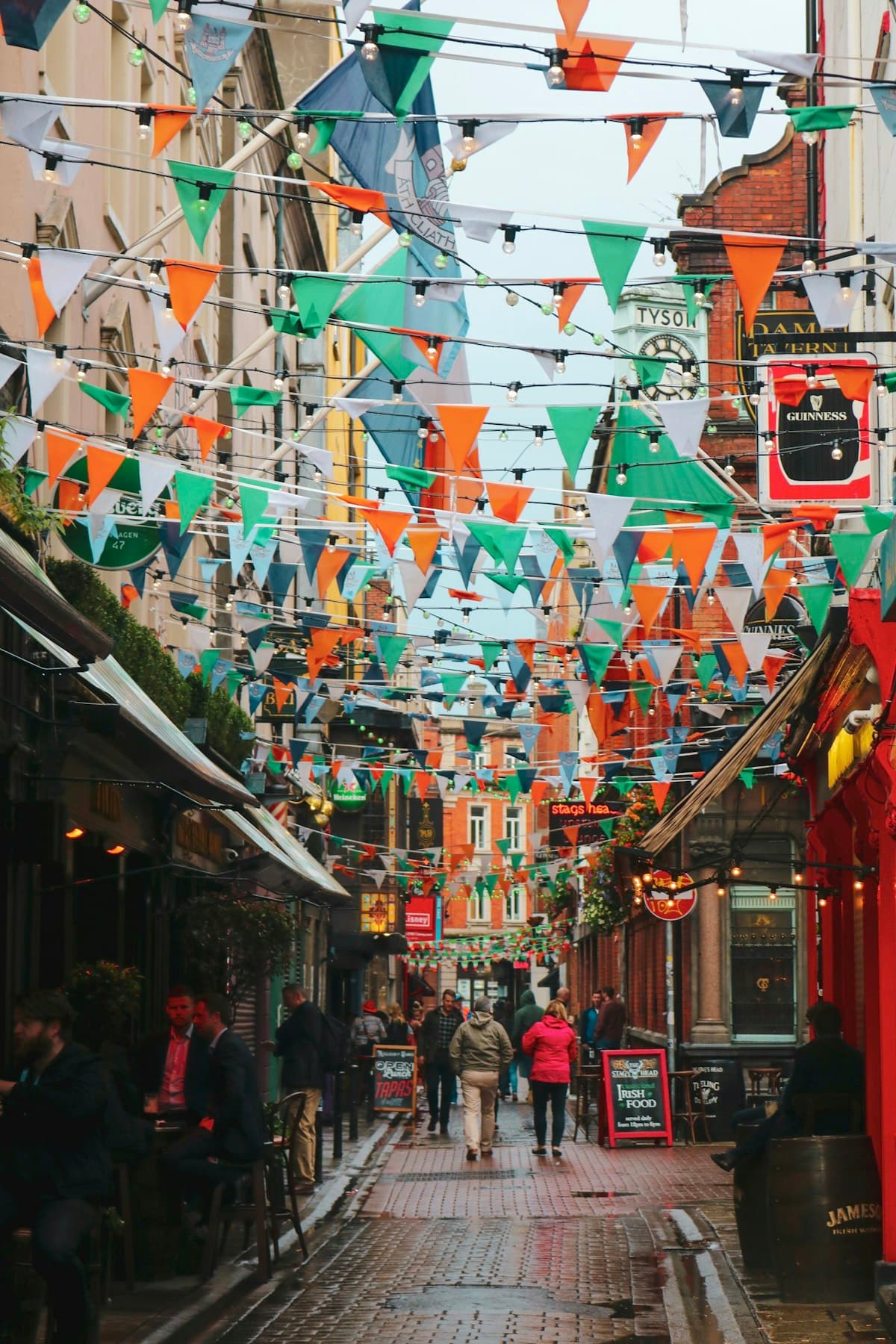
- The Stag's Head (Dame Court): a beautiful Victorian pub, mosaic floor at the entrance, and reasonable prices. A locals' favourite.
- Mulligan's of Poolbeg Street: said to pour the best pint of Guinness in Dublin (a claim several others also make). Pubs near the river skew tourist; Mulligan's is a working bar.
- Grafton Street: the main pedestrian shopping street between Trinity College and St. Stephen's Green. Buskers all afternoon — Glen Hansard and Damien Rice both started here.
Tip: Go to Temple Bar for the music and the streets, but don't make it your only drinking spot. Walk five minutes in any direction — into the Liberties, up to Camden Street, or across the river to Capel Street — and pints drop from €9 to €5–6 with no loss of atmosphere.
8. EPIC — The Irish Emigration Museum
Three-time winner of "Europe's Leading Tourist Attraction" at the World Travel Awards (2019, 2020, 2021), EPIC is consistently the best-reviewed museum in Ireland. It tells the story of the 10 million Irish people who emigrated and the influence they had on the world — from US presidents to writers to revolutionaries.
The museum is entirely interactive — no artifacts, just 20 galleries of touchscreens, video, audio, and immersive installations. It's in the vaulted basement of the old CHQ tobacco warehouse on the docklands, a beautiful 1820s building.
Tip: Tickets are around €19 online. Allow 90 minutes for the full visit. If you have Irish heritage, the on-site Irish Family History Centre lets you trace your ancestry with the help of a genealogist (separate booking; around €30 for a 30-minute consultation).
9. Phoenix Park
Phoenix Park is one of the largest enclosed urban parks in Europe — 1,750 acres, more than twice the size of New York's Central Park — and one of the genuinely unique things about Dublin. It's home to a wild herd of fallow deer that has roamed the park since 1662, the tallest obelisk in Europe, the Irish president's official residence, and the oldest zoo in Ireland.
What's in the park:
- The fallow deer herd: around 500 deer roam free, descended from those introduced under King Charles II. Best seen at dawn or dusk near the Papal Cross. Keep a respectful distance — they're wild.
- The Wellington Monument: at 62 meters, the tallest obelisk in Europe, completed in 1861 to commemorate the Dublin-born Duke of Wellington.
- Áras an Uachtaráin, the official residence of the President of Ireland: free guided tours on Saturdays only (book ahead via OPW; bring your passport).
- Farmleigh House: a 78-acre estate on the park's edge, formerly a Guinness family residence, now used for visiting heads of state. Free to visit, with extensive gardens and a weekend food market.
- Dublin Zoo: one of the oldest zoo collections in Europe (opened 1831), 64 acres in the park's southeast corner. Around €25 entry.
Tip: The park is 2 km from the city centre — too far to walk comfortably round-trip with sightseeing. Rent a bike at the main gate (Phoenix Park Bikes, around €10/hour) or take the 25 or 26 bus from the city centre. Allow at least half a day. The Phoenix Café in the park's centre serves decent coffee and lunch.
10. National Museum of Ireland — Archaeology
If you only visit one free museum in Dublin, make it this one. The National Museum of Ireland — Archaeology houses Ireland's finest collection of prehistoric, Viking, and medieval artifacts in a stunning 1890 Victorian building on Kildare Street, two minutes from Trinity College.
What you'll see:
- The Tara Brooch and Ardagh Chalice: two of the finest pieces of Celtic metalwork ever produced, both from the 8th–9th centuries. They're the single best argument that medieval Ireland was a centre of European craft.
- The Cross of Cong: a 12th-century processional cross said to have contained a fragment of the True Cross.
- Bog bodies: four Iron Age bodies preserved in Ireland's peat bogs for over 2,000 years. Eerie, fascinating, and presented with real respect.
- The Treasury: the largest collection of prehistoric gold artifacts in Western Europe — torcs, lunulae, and discs spanning the Bronze Age.
- The Viking Dublin gallery: artifacts excavated from the 9th-century Viking settlement at Wood Quay, including ships' timbers, weapons, and household objects.
Tip: Free entry. Allow 90 minutes for a proper visit, longer if you read the labels. Closed Mondays. The neighbouring National Library and National Gallery — both also free — make for an excellent free half-day on Kildare and Merrion Squares.
11. Croke Park & the GAA Museum
Croke Park is the headquarters of the Gaelic Athletic Association and the third-largest stadium in Europe — but more importantly, it's the cultural home of Gaelic football and hurling, two sports that exist almost nowhere else in the world. A stadium tour is one of the most uniquely Irish experiences you can have in Dublin.
Why it matters:
- The Bloody Sunday memorial: in November 1920, during the War of Independence, British forces opened fire at a Gaelic football match here, killing 14 spectators including a player on the pitch. The memorial is moving in a way that doesn't translate to text.
- The GAA Museum: traces the history of Gaelic games, the GAA's central role in Irish independence, and the all-amateur structure of the sport (every player has a day job).
- The stadium itself: 82,300-capacity, used for the All-Ireland Football and Hurling finals every September — Ireland's biggest sporting events.
- A live match: if you're in Dublin during championship season (June–September), the atmosphere at a Dublin GAA football game is unlike anything in European sport. Often standing-room only.
Tip: The combined stadium tour + museum is around €18, runs daily. The Skyline Tour — a guided walk along the roof of the stadium — is €25 and worth it for the views over Dublin. If you can catch a championship match, do it: tickets for non-premium games are often available on the day from the official GAA site.
12. St. Stephen's Green & Grafton Street
If Dublin has a central plaza, it's St. Stephen's Green — a 22-acre Victorian park surrounded by Georgian buildings, with a lake, a bandstand, dozens of benches, and statues of W.B. Yeats, James Joyce, and Wolfe Tone. The park was the site of fighting during the 1916 Rising: rebels dug trenches across the lawn, and plaques throughout the park mark where they fought.
Grafton Street, running north from the park to Trinity College, is Dublin's main pedestrian shopping street — 400 metres of buskers, flower sellers, Brown Thomas department store, and the bronze Molly Malone statue at the bottom end.
What to do here:
- Walk the park in 20 minutes: enter from Grafton Street, follow the lake counter-clockwise past the Yeats memorial, the bandstand, and back out.
- Find the buskers on Grafton Street: Glen Hansard, Damien Rice, and Hozier all started here. The afternoon crowd has the strongest performers.
- Pose with Molly Malone: a 1988 bronze of the fictional fishmonger from the traditional Dublin song, at the bottom of Grafton Street.
- The Shelbourne Hotel on the corner: 1824, where the Irish Constitution was drafted in 1922. Worth a peek into the lobby and the Horseshoe Bar.
- The Iveagh Gardens, hidden behind the National Concert Hall three minutes from the Green: a 19th-century Victorian garden with a maze, a rosarium, and almost no tourists. Locals call it 'the Secret Garden.'
Tip: Both the park and the street are free. The Iveagh Gardens are a local favourite for picnics — grab a sandwich from one of the cafés on South King Street and head over.
13. The Ha'penny Bridge & a River Liffey Walk
The Ha'penny Bridge — formally the Liffey Bridge — is the most photographed bridge in Ireland. Built in 1816 as a cast-iron pedestrian crossing, it earned its nickname from the half-penny toll charged to cross until 1919. The white-painted iron arches over the dark river are on every Dublin postcard for a reason.
But the bridge is even better as one stop on a longer walk. The full length of the Liffey through central Dublin takes 30–40 minutes and packs a remarkable amount of history into a small distance.
The walk, east to west:
- Start at the Custom House (1791) on the docklands: one of Dublin's grandest Georgian buildings, with a memorial garden for Famine victims.
- Walk west along Eden Quay, past Liberty Hall (Ireland's tallest building when it was built in 1965).
- Stop at the Famine Memorial sculptures by Rowan Gillespie — six gaunt bronze figures walking toward the Custom House. Among the most powerful pieces of public art in Europe.
- Cross the Ha'penny Bridge: the photo spot. Best light is early morning or late afternoon.
- Continue along Wellington Quay through the Temple Bar district.
- End at the Four Courts (1796), the seat of Ireland's High Court and Supreme Court, with its iconic green dome (rebuilt after being shelled during the Civil War in 1922).
Tip: Worth doing on both a sunny afternoon and a rainy one — Dublin shifts character with the weather. The river is tidal; at low tide you can see the river bed exposed in places.
14. The Little Museum of Dublin
A small museum about a small city, run by passionate guides who make it one of the most consistently top-rated experiences in Dublin. The Little Museum is housed in a Georgian townhouse on St. Stephen's Green and tells the story of 20th-century Dublin — independence, the Pope's visit, U2, the Celtic Tiger, and the financial crash — through everyday objects donated by Dubliners.
What makes it special:
- The 30-minute guided tour: led by storytellers who are funny, sharp, and pack a century of context into a short visit. This isn't a museum to read — it's one to listen to.
- The 'U2 Room': a small exhibition of memorabilia from the band's early years, donated by the band themselves.
- The artifacts: items range from John F. Kennedy's lectern (used for his 1963 Dublin speech) to original ads from independent Ireland to a chamber pot from 1916.
Tip: Tickets are around €15 and tours run hourly. Book online — the tours sell out daily in summer. The whole experience takes 45 minutes; it's an excellent palate-cleanser between heavier museum visits.
15. The GPO & the 1916 Rising Story
The General Post Office on O'Connell Street is the most important building in modern Irish history. On Easter Monday 1916, Patrick Pearse stepped out onto its portico and read the Proclamation of the Irish Republic — the moment the Easter Rising began, and the spark that led, six years later, to Irish independence. The building was shelled to ruins during the Rising and rebuilt in 1929.
It's still a working post office, but the basement now houses GPO Witness History, an interactive museum dedicated to the Rising and the path to independence.
What you'll see:
- An original copy of the Proclamation: one of fewer than 30 surviving copies of the document Pearse read out, displayed under glass.
- The bullet-marked stone columns at the front of the GPO: still visible from the British shelling.
- Letters and personal effects from the leaders executed at Kilmainham — including from James Connolly and Patrick Pearse.
- A 12-minute audiovisual recreation of the Rising's six days, drawn from eyewitness accounts.
Tip: Around €15. Pair this with Kilmainham Gaol (a 25-minute Luas Red Line trip away) for the complete picture of 1916 — the Rising's beginning at the GPO, its ending at Kilmainham. Together they're the most coherent way to understand modern Irish history in two half-days.
Day Trips from Dublin
Dublin is one of the best bases in Europe for day trips — some of Ireland's most dramatic scenery is within a two-hour drive.
Giant's Causeway & Belfast (Northern Ireland — 2.5 hrs)
The 40,000 basalt columns at the Giant's Causeway are Ireland's only UNESCO World Heritage Site and one of Europe's great natural wonders. Most full-day tours from Dublin combine the Causeway with the Dark Hedges (the 'King's Road' from Game of Thrones), Dunluce Castle ruins, and a stop at the Titanic Belfast museum. Long day (10–12 hours), but the most spectacular day trip you can do from Dublin.
Howth (30 min by DART)
A working fishing village on a peninsula at the end of the DART line. Cliff walk loop with 360° views over Dublin Bay, fresh seafood at the harbour pubs (Aqua and the Oar House are the local picks), and an easy half-day. Best for a sunny afternoon. Bring a wind jacket.
Wicklow Mountains & Glendalough (1 hr by car or tour)
The 'Garden of Ireland' — bog-covered mountains, a 6th-century monastic site at Glendalough founded by St. Kevin, and walks around two glacial lakes. Featured in Braveheart, P.S. I Love You, and Vikings. Best done with a tour bus or rental car; public transport is limited.
Cliffs of Moher & Galway (2.5–3 hrs)
The most famous cliffs in Ireland — 700 feet straight down into the Atlantic — and the medieval city of Galway on Ireland's west coast. Long day from Dublin (12+ hours by tour bus) but doable, and the cliffs are unforgettable. Consider an overnight in Galway if you want to enjoy it properly.
Kilkenny & Kells (90 min by train)
Medieval Kilkenny is one of Ireland's prettiest small cities, with a 12th-century castle, a beautifully preserved medieval mile, and excellent pubs. Trains from Dublin Heuston take 90 minutes. Can be combined with a stop at the Hill of Tara or Newgrange (Ireland's 5,000-year-old passage tomb, older than the pyramids).
Getting Around Dublin
Dublin's centre is so small that you'll walk almost everywhere. Public transport mostly matters for the airport, Kilmainham, and day trips.
Walking
The honest answer for almost everything in the city centre. Trinity College to Christ Church is 12 minutes on foot. Trinity to the Guinness Storehouse is 25 minutes. There's no Tube here — the city is too small to need one.
Luas (light rail)
Two lines: the Red Line (east-west, useful for Kilmainham and the Guinness Storehouse) and the Green Line (north-south, useful for the airport bus stop and Ranelagh). Fares are €2–3. Buy a Leap Card or use contactless.
DART (coastal commuter rail)
Runs along Dublin Bay. The only way you'll use it is for day trips to Howth (30 min north), Dún Laoghaire (15 min south), or Bray. Single fares around €4.
Dublin Bus
Extensive network. You'll mainly use it for the Aircoach/Dublin Express airport buses (around €8 from the airport to the city centre, every 15 minutes). Tap on with contactless or a Leap Card.
Taxis & Uber
Black-and-yellow Dublin taxis run on metered fares. There's no Uber X in Ireland — Uber here only books licensed taxis at the same metered rate, so just use FreeNow (the local app) or hail one. Expect €10–15 for most journeys within central Dublin.
The Best Free Things to Do in Dublin
Dublin's national museums and libraries are all free — one of the best deals in any European capital.
- National Museum of Ireland — Archaeology: the bog bodies, Tara Brooch, Ardagh Chalice, and Iron Age gold collection are world-class. Free.
- National Museum of Ireland — Decorative Arts & History: at Collins Barracks, covering Irish history from 1916 onward. Free.
- National Gallery of Ireland: Caravaggio's 'Taking of Christ' (lost for 200 years and rediscovered in a Jesuit dining room in Dublin in 1990) is here, alongside Vermeer, Monet, and the largest collection of Jack B. Yeats paintings anywhere. Free.
- Chester Beatty Library: one of Europe's finest collections of manuscripts and Asian art, in Dublin Castle's grounds. Free.
- Trinity College campus (excluding the Book of Kells): walk through Parliament Square and the cobbled courtyards. Free.
- Phoenix Park: one of Europe's largest urban parks — 1,750 acres, twice the size of Central Park. Home to wild fallow deer, the Wellington Monument, and Áras an Uachtaráin (the Irish president's residence). Free.
- St. Stephen's Green: 22-acre Victorian park in the centre, perfect for a midday break.
- The Iveagh Gardens: a hidden Victorian garden two minutes from St. Stephen's Green — almost no tourists, locals call it 'the Secret Garden.'
- Walking the river Liffey from O'Connell Bridge to the Docklands: 30 minutes of changing architecture, the Ha'penny Bridge, and the Famine Memorial sculptures.
Book a Guided Tour
My wife and I book at least one guided tour on almost every international trip we take, and Dublin is one of the cities where it pays off most. Kilmainham Gaol is guided-only, the Giant's Causeway day trip is a full-day operation that's effectively impossible without a tour bus, and Dublin's 1,000 years of history reward a good guide far more than they reward wandering with a map.
The walking tours — there are excellent free walking tours that work on tips, plus paid history and pub tours — are the fastest way to orient yourself when you arrive. The Giant's Causeway combos and the Cliffs of Moher tours are where pre-booking really matters: the operators have deals on entry tickets, parking, and timing that you simply can't replicate independently.
Staying Connected in Dublin
Ireland has excellent 4G coverage everywhere in Dublin and expanding 5G in the city centre. You'll want data for Google Maps, the Luas and DART ticketing apps, restaurant bookings, and FreeNow for taxis.
International roaming is expensive. AT&T and Verizon both charge $12/day for Irish roaming. A travel eSIM for Ireland starts at $2.99 for 1 GB over 7 days, with unlimited plans from Airalo, Saily, and Holafly for longer trips.
Combining Dublin with Northern Ireland or Britain? Ireland is in the EU and the UK isn't. Most EU eSIMs don't cover the UK, including Northern Ireland. If you're doing a Giant's Causeway day trip, going on to London, or crossing the border at all, look for a regional plan that covers both — or pair an Ireland plan with a separate UK plan.
Compare eSIM Plans for Ireland
We've compared plans from Airalo, Saily, Holafly, and more. Find the best data plan for your Dublin trip.
Compare Ireland eSIM PlansFrequently Asked Questions
▶How many days do you need in Dublin?
Two to three days covers Dublin's main highlights: the Guinness Storehouse, Trinity College and the Book of Kells, Kilmainham Gaol, a whiskey distillery tour, and a wander through Temple Bar. Add a fourth day for a day trip — Howth on the coast, Giant's Causeway in Northern Ireland, or the Wicklow Mountains and Glendalough. Five days lets you cover the city properly and fit two day trips.
▶Is Dublin expensive?
Dublin is one of Europe's more expensive cities, comparable to London or Amsterdam. Expect €4–6 for a pint of Guinness, €15–25 for a casual meal, and €30–50 for mid-range dining. Hotels in the city centre run €180–300 per night in peak season. Many of the best things to do — the National Museum, the National Gallery, St. Stephen's Green, walking the city — are free. Budget €150–200 per day per person for a comfortable trip including one paid attraction.
▶When is the best time to visit Dublin?
May to September is peak season, with the longest days (sunset after 9 PM in June) and the best chance of dry weather. June and September are the sweet spots — fewer crowds than July–August, prices a notch lower, and weather still mild (15–20°C). March is busy and pricey around St. Patrick's Day. November to February is the cheapest time, but expect short days, frequent rain, and earlier closures for some sites.
▶Do I need a visa to visit Ireland?
US, Canadian, Australian, and most EU citizens can visit Ireland visa-free for up to 90 days. Ireland is in the EU but not in the Schengen Area, so it has its own border controls. Ireland is also not joining the EU's new Entry/Exit System (EES) — you'll get a regular passport stamp on entry, not a biometric scan. If you're combining Dublin with a Schengen country trip (like France or Italy), check the EES rules for that leg separately.
▶Is Dublin walkable?
Yes — Dublin's centre is small and very walkable. Most of the major sights (Trinity College, Temple Bar, Dublin Castle, Christ Church, St. Patrick's Cathedral, Grafton Street) sit within a 25-minute walk of each other. The Guinness Storehouse is a 25-minute walk west of the centre or a short taxi/Luas ride. Kilmainham Gaol is further out — take the Luas Red Line to Suir Road and walk 10 minutes, or take a taxi (around €12 from the centre).
▶Is Temple Bar worth visiting?
Yes for the atmosphere, no for the prices. Temple Bar is the most photographed pub in Ireland and the area is a key part of Dublin's tourist experience, with cobbled streets, live trad music, and a real buzz at night. But a pint at The Temple Bar pub itself runs €9–11 versus €5–6 at quieter pubs five minutes away. Go for the music and the photos, then drink somewhere else.
▶Does my phone work in Ireland?
Ireland has excellent 4G and growing 5G coverage across Dublin and most of the country. AT&T and Verizon both charge about $12/day for Irish roaming. A travel eSIM for Ireland costs as little as $2.99 for 1 GB over a week, with unlimited data plans available from providers like Airalo, Saily, and Holafly. Note that Ireland and the UK use different networks — if you're combining Dublin with Belfast or a Giant's Causeway day trip, look for an EU + UK plan or a regional plan that covers both.