Disclosure: This guide contains affiliate links. If you purchase through our links, we may earn a small commission at no extra cost to you.
Singapore packs more into 720 square kilometers than most cities manage in ten times the space. It's a glass-and-steel financial capital, a tropical garden city, a working multi-ethnic society, and a hawker food destination — all stitched together by what is probably the cleanest, most efficient public transit network on Earth.
The thing that surprises most first-time visitors is how walkable and connected it is. The MRT subway covers everywhere you'll want to go, with trains every 2–3 minutes, and Grab fills the gaps cheaply. English is the working language, signage is multilingual, and you can land at Changi in the morning and be eating chili crab on the bay by sunset without breaking a sweat.
Below are ten things to do in Singapore, ordered roughly by priority for a first visit. Each entry tells you what it's actually like, what it costs, how long to plan, and whether a guided tour is worth booking.
Planning Your Visit
A few practical things to know before you book anything:
Singapore basics:
- Best months: February–April is the driest. November–December is the wettest (Northeast Monsoon — short, intense afternoon downpours). Temperature is 30°C year-round with no real off-season.
- How long: 3 days for the highlights, 5 days is the sweet spot, a week if you want a Sentosa beach day and a Pulau Ubin trip without rushing.
- Getting around: the MRT (subway) is excellent — clean, air-conditioned, and reaches every tourist area. A Singapore Tourist Pass (SGD 17 for 1 day, SGD 24 for 3 days) gives unlimited rides. Grab fills in the gaps.
- Currency: Singapore Dollar (SGD). USD 1 ≈ SGD 1.35. Cards are accepted nearly everywhere, including most hawker stalls. Cash is helpful for small old-school stalls and Pulau Ubin.
- Dress code: light, breathable clothing. Tank tops and shorts are normal everywhere except temples and mosques (cover shoulders and knees). Bring a light layer — every indoor space is air-conditioned aggressively.
- Tipping: not customary. Restaurants add a 10% service charge automatically. Tipping taxi drivers or hotel staff is appreciated but not expected.
One rule: book Universal Studios, S.E.A. Aquarium, and the Marina Bay Sands SkyPark slots in advance during weekends and Singapore school holidays. Same-day tickets are usually available, but timed slots and skip-the-line tickets save 30+ minutes.
1. Marina Bay & the SkyPark
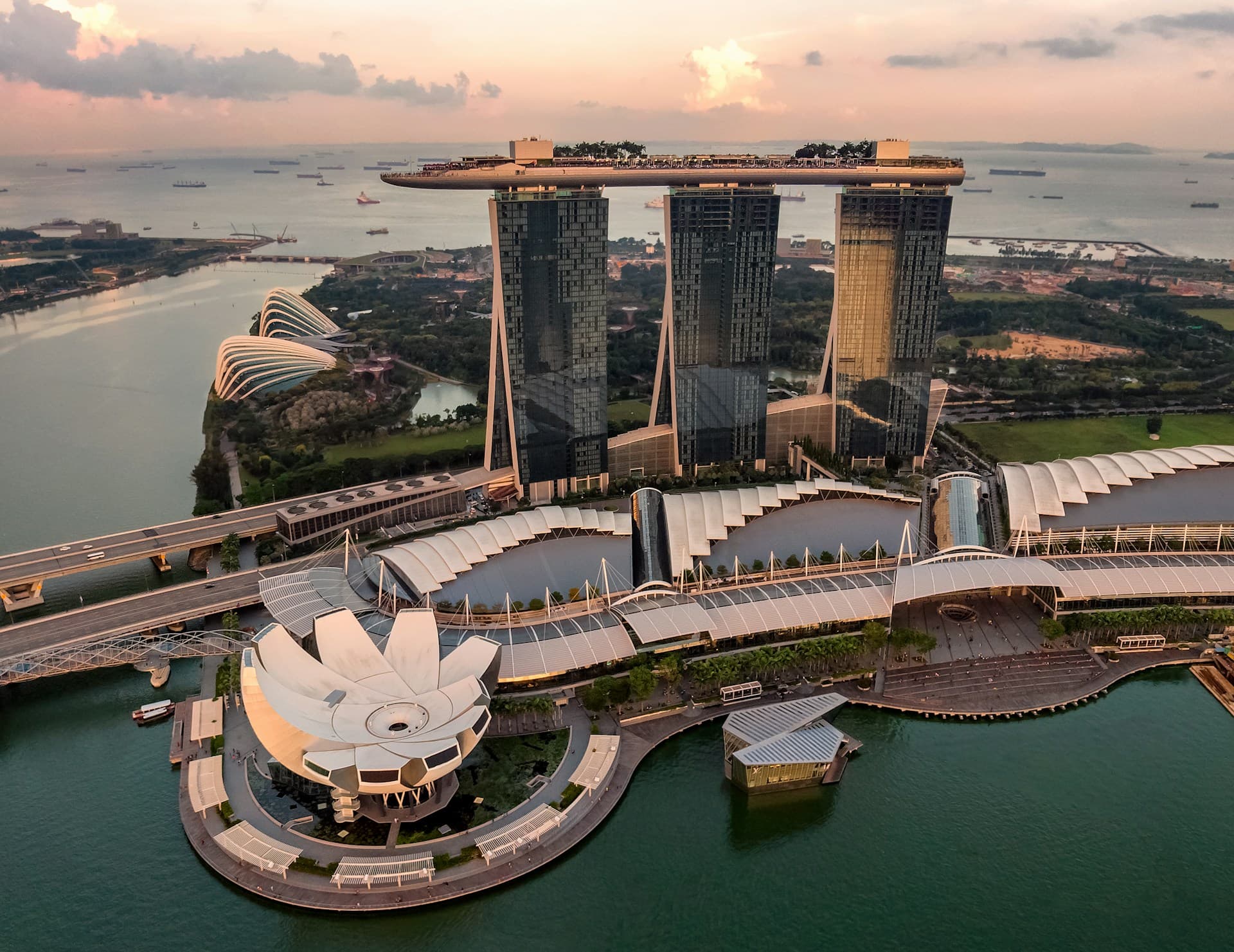
Marina Bay is the postcard view of Singapore — the three-tower Marina Bay Sands hotel topped by the SkyPark (a 340-meter rooftop deck shaped like a boat), the Helix Bridge curving across the water, the lotus-shaped ArtScience Museum, and the Merlion fountain spitting into the bay across from it all. The whole amphitheater comes alive at 8 PM and 9 PM nightly with Spectra, a free 15-minute light and water show synced to music.
The SkyPark Observation Deck is open to non-hotel guests and gives a 360° view across the bay, the financial district, and the Strait of Singapore. The famous infinity pool (the one from every Instagram you've seen) is hotel-guest only — but you don't need a room to take in the same view from the deck or, even better, from one of the two rooftop bars (Cé La Vi or Lavo) that share the top of the building.
At a glance:
- Time on site: 2–3 hours including the SkyPark deck and Spectra; longer if you add the ArtScience Museum or a bay cruise.
- Cost: SkyPark Observation Deck SGD 32 (~USD 24). Spectra light show: free. Bumboat bay cruise: SGD 15–25.
- Best timing: arrive 90 minutes before sunset for the SkyPark, then walk along the waterfront promenade and catch Spectra at 8 PM.
- Free alternative: the Helix Bridge and the Merlion Park give nearly the same skyline view at no cost — and the best Spectra viewing position is the steps in front of the Merlion.
- Don't miss: a drink at Cé La Vi at sunset — pricey (SGD 25–30 per cocktail) but a cheaper alternative to a SkyPark ticket and gets you the view at the right time.
Klook
Marina Bay Sands SkyPark Tickets
Pre-booked SkyPark Observation Deck tickets, plus combo passes with the ArtScience Museum and bay cruises.
2. Gardens by the Bay
Gardens by the Bay is what happens when a city decides to build a garden the size of a small town. The 250-acre site sits on reclaimed land east of Marina Bay Sands and contains three set-piece attractions: the Cloud Forest (a 35-meter indoor mountain wrapped in mist with the world's tallest indoor waterfall), the Flower Dome (the world's largest glass conservatory, with rotating seasonal floral exhibits), and the Supertree Grove — 18 vertical gardens 25–50 meters tall that put on a free light-and-music show called Garden Rhapsody at 7:45 PM and 8:45 PM nightly.
The two domes are climate-controlled and air-conditioned — a welcome break from Singapore's humidity. The Supertrees and outdoor gardens are free to walk through at any hour, and the OCBC Skyway (a 128-meter elevated walkway between two of the Supertrees) gives a view back across Marina Bay that rivals the SkyPark.
At a glance:
- Time on site: 3–4 hours for both domes plus the Supertrees and the Garden Rhapsody show.
- Cost: Cloud Forest + Flower Dome combo SGD 53 (~USD 39). OCBC Skyway SGD 14 (~USD 10). Outdoor gardens and Supertrees: free.
- Best timing: late afternoon — visit the domes before they close at 9 PM, then walk to the Supertrees for the 7:45 PM Garden Rhapsody show.
- Free version: skip the domes and just see the Supertrees and Garden Rhapsody at night — the outdoor gardens alone justify the trip.
- Don't miss: the Cloud Forest waterfall hits its full 35-meter drop right at the entrance — your phone camera will fog up immediately, so bring a cloth.
Klook
Gardens by the Bay Tickets & Combos
Cloud Forest + Flower Dome combo tickets, OCBC Skyway passes, and bundles with Marina Bay Sands SkyPark.
3. Sentosa Island
Sentosa is Singapore's resort island — connected to the mainland by a 700-meter causeway, a Cable Car, the Sentosa Express monorail, and a free pedestrian boardwalk. It packs Universal Studios Singapore (Southeast Asia's largest theme park, with the Transformers, Sci-Fi City, and Ancient Egypt zones), the S.E.A. Aquarium (one of the largest in the world), three sandy beaches (Siloso, Palawan, and Tanjong), Adventure Cove waterpark, and the Skyline Luge that lets you race down the hillside on gravity-powered carts.
You can spend a half-day or a full week here. The most efficient first visit is Universal Studios in the morning, Skyline Luge in the late afternoon, and dinner on Siloso Beach with a view of the cargo ships in the strait. Sentosa is more touristy than the rest of Singapore but it's genuinely good — Universal Studios in particular punches well above its weight.
At a glance:
- Time on site: a full day for Universal Studios + one other attraction; a half-day for the Cable Car, Skyline Luge, and a beach.
- Cost: Universal Studios SGD 83 (~USD 61). S.E.A. Aquarium SGD 44 (~USD 33). Skyline Luge 4-ride pass SGD 29 (~USD 21). Mount Faber Cable Car round-trip SGD 35 (~USD 26).
- Best timing: weekday mornings at Universal (lines triple on weekends and Singapore school holidays).
- Getting there: the Sentosa Express monorail from VivoCity (the mall at HarbourFront MRT) is the easiest entry — SGD 4 each way.
- Skip if pressed: Madame Tussauds and Trick Eye Museum. Both fine but they're not why you came to Singapore.
Klook
Sentosa Tickets — Universal Studios & More
Universal Studios Singapore, S.E.A. Aquarium, Skyline Luge, the Cable Car, and Sentosa Pass combo tickets.
4. Chinatown
Chinatown is one of Singapore's three main heritage districts and easily the busiest. The restored shophouses along Pagoda Street and Trengganu Street are now galleries, clan halls, traditional medicine shops, and street-food stalls. The Buddha Tooth Relic Temple at the south end is a five-story Tang Dynasty-style temple opened in 2007 — gold Buddha hall on the ground floor, a rooftop garden with a massive prayer wheel up top, and a small but excellent Buddhist culture museum in between. Two blocks away, the Sri Mariamman Temple is the oldest Hindu temple in Singapore (built in 1827), with a riot of polychrome figures stacked up its gopuram tower.
The Chinatown Complex (a hawker center on Smith Street) holds the cheapest Michelin-starred meal in the world: Liao Fan Hong Kong Soya Sauce Chicken Rice and Noodle — a soya sauce chicken rice plate for SGD 4 (~USD 3). Be patient with the queue.
At a glance:
- Time on site: a full half-day for the temples + Chinatown Complex hawker meal + walking the heritage streets.
- Cost: free to walk, free to enter all temples (Buddha Tooth Relic asks for a small donation). Hawker meals SGD 4–8.
- Best timing: late morning into early afternoon for the markets; evening for the lit-up shophouses and Trengganu Street.
- Don't miss: the Maxwell Food Centre (3-minute walk from Chinatown MRT) — Tian Tian Hainanese Chicken Rice was Anthony Bourdain's favorite plate of food in Singapore.
- Modesty: shoulders and knees covered at the Hindu and Buddhist temples. Shoes off at the Sri Mariamman.
GetYourGuide
Singapore Food Tours & Heritage Walks
Guided food tours through Chinatown, Little India, and Kampong Glam — the three heritage districts in one half-day.
5. Little India
Little India is the most sensorially intense neighborhood in Singapore — and the one most travelers underrate. It runs north of the Rochor River along Serangoon Road, and hits with marigold garlands at every corner, sari shops, gold dealers, the call to prayer from the Abdul Gafoor Mosque, and the smell of cumin and sandalwood. The Sri Veeramakaliamman Temple (dedicated to Kali) is open to visitors with shoes off and shoulders covered. The Tan Teng Niah House on Kerbau Road — a riot of fluorescent reds, yellows, blues, and greens on a two-story Chinese villa — is the most photographed building in the district.
The Tekka Centre at the south end is the food anchor: a multi-level wet market downstairs and a hawker center upstairs serving the city's best fish-head curry, biryani, masala dosa, and banana-leaf thalis. Plates run SGD 6–10.
At a glance:
- Time on site: 2–3 hours for the temple, the streets, and a Tekka Centre meal.
- Cost: free to walk and enter all temples. Tekka Centre meals SGD 6–10.
- Best timing: late afternoon for the lights and smells; Sunday brings the biggest crowds and the most energy.
- Don't miss: kaya toast and a kopi (local strong coffee with condensed milk) at one of the old-school kopitiams along Serangoon Road.
- Photo spot: the Tan Teng Niah House on Kerbau Road — early morning has the best light and fewest tour groups.
6. Kampong Glam & Haji Lane
Kampong Glam is the historic Malay-Arab quarter — small, walkable, and the most aesthetically Instagram-friendly of Singapore's heritage districts. The gold-domed Sultan Mosque (Masjid Sultan, built in 1824) anchors it and is open to visitors outside prayer times, with robes provided for those in shorts and tank tops. Bussorah Street leading up to the mosque is a tree-lined pedestrian lane of carpet shops, cafés, and Persian rug dealers — possibly the prettiest street in the city.
Haji Lane, one block south, is the boutique strip — a 300-meter alley of independent fashion stores, vintage shops, and bars covered in murals so dense the walls themselves are the attraction. Arab Street holds the Middle Eastern food: shisha bars, Lebanese mezze, Turkish coffee, and some of the best baklava outside Istanbul.
At a glance:
- Time on site: 2 hours for the mosque, Haji Lane, and a meal on Arab Street.
- Cost: free to walk. Sultan Mosque entry free. Meals SGD 15–35.
- Best timing: late afternoon into evening — Haji Lane comes alive after dark with the bars.
- Don't miss: dinner at Zam Zam (since 1908) for Indian-Muslim murtabak — the closest thing Singapore has to a culinary heirloom.
- Modesty: cover shoulders and knees inside Sultan Mosque. Robes are loaned at the entrance.
7. Hawker Centers — A Singapore Food Crawl
If you do nothing else in Singapore, eat at a hawker center. They're open-air food courts where dozens of family-run stalls — many of them third-generation or older — serve the dishes that define Singaporean cuisine for SGD 5–8. UNESCO inscribed Singapore's hawker culture on its Intangible Heritage list in 2020. Two stalls have Michelin stars; many more have lines that stretch around the block.
Don't miss the national dishes: Hainanese chicken rice (the unofficial national dish — poached chicken with fragrant rice and chili-ginger sauce), char kway teow (stir-fried flat rice noodles with cockles, prawns, and Chinese sausage), laksa (coconut curry noodle soup with shrimp), chili crab (Singapore's signature seafood dish), satay (grilled skewers with peanut sauce), and kaya toast for breakfast.
Best hawker centers to try:
- Maxwell Food Centre (Chinatown) — Tian Tian Hainanese Chicken Rice was Anthony Bourdain's favorite plate of food in Singapore.
- Lau Pa Sat (CBD) — a beautifully restored Victorian-era cast-iron hall. Satay Street outside opens at 7 PM and is the city's best satay scene.
- Newton Food Centre (Newton MRT) — featured in Crazy Rich Asians; seafood-heavy and slightly touristy but legitimately good.
- Old Airport Road Food Centre (Mountbatten) — local-favorite, lower-tourist hawker. Lor Mee, Hokkien mee, and oyster omelette are iconic here.
- Chinatown Complex Smith Street — the cheapest Michelin-starred meal in the world (Liao Fan Soya Sauce Chicken — SGD 4–5).
- Tekka Centre (Little India) — fish-head curry, biryani, banana-leaf thalis. Best Indian-Singaporean food in the city.
Tip:"chope" culture — locals reserve a hawker table by leaving a packet of tissues on it before queuing. Respect the tissue. Pay cash at older stalls; most newer ones accept PayNow QR and contactless cards.
8. Singapore Zoo & Night Safari
The Mandai Wildlife Reserve in Singapore's north holds four parks on a single rainforest campus: Singapore Zoo (open-concept, by daylight), the Night Safari (the world's first nocturnal zoo, opens at 7:15 PM), River Wonders (Asia's first river-themed wildlife park, with pandas), and Bird Paradise (the new aviary that opened in 2023). Singapore Zoo is consistently rated among the top three zoos in Asia, and the Night Safari is a genuinely original concept that no other major city replicates.
The orangutan free-ranging area at Singapore Zoo is the signature exhibit — the apes move freely overhead on a rope canopy with no barriers between them and the path. The Night Safari runs a tram tour through eight regional habitats lit by warm low-level lighting, plus walking trails through the same enclosures. Both parks are best done as a combo: Zoo in late afternoon, an early dinner at one of the Mandai restaurants, then Night Safari at 7:15.
At a glance:
- Time on site: 4 hours for the Zoo, 2.5 hours for the Night Safari, a full day for both with River Wonders or Bird Paradise added.
- Cost: Singapore Zoo SGD 49 (~USD 36). Night Safari SGD 56 (~USD 41). 4-park Mandai Pass: SGD 99 (~USD 73) — the best value if you're doing more than two.
- Best timing: Zoo from 2 PM (cooler, fewer crowds), Night Safari at the 7:15 opening (the animals are most active in the first hour).
- Getting there: Mandai is in northern Singapore — the dedicated Mandai Khatib Bus Express from Khatib MRT runs every 20 minutes (SGD 1).
- Don't miss: the Fragile Forest walk-through aviary at Singapore Zoo and the Wallaby Trail at Night Safari.
Klook
Singapore Zoo & Night Safari Tickets
Single tickets and 4-park Mandai Pass for the Zoo, Night Safari, River Wonders, and Bird Paradise.
9. Singapore Botanic Gardens & Orchard Road
The Singapore Botanic Gardens are one of three gardens in the world UNESCO has named a World Heritage Site (alongside Kew in London and Padua in Italy) — and they're free to enter. The 82-hectare park stretches from the Tanglin Gate near Orchard Road to the Bukit Timah Gate in the north, with rainforest, the Swan Lake, the Symphony Lake bandstand, and the National Orchid Garden (a paid section, SGD 15, with 1,000+ orchid species and hybrids — the largest display in the world).
Orchard Road, just south of the Botanic Gardens, is Singapore's shopping spine — a 2.2-kilometer boulevard of mega-malls (ION Orchard, Ngee Ann City, Paragon) and flagship stores. The architecture of ION Orchard alone is worth a walk-through. The pairing — a slow tropical garden morning followed by an air-conditioned Orchard Road afternoon — is the city's most relaxed day off from sightseeing.
At a glance:
- Time on site: 2–3 hours for the Botanic Gardens; another 2 hours if you walk Orchard Road.
- Cost: Botanic Gardens free. National Orchid Garden SGD 15 (~USD 11). Orchard Road shopping at international prices (slightly cheaper than US, similar to UK).
- Best timing: Botanic Gardens at 7–10 AM (open from 5 AM, coolest in the morning, fewest crowds).
- Free events: open-air concerts at the Symphony Lake bandstand most weekends; check the Botanic Gardens calendar.
- Skip if pressed: Orchard Road is fine but it's not a destination. If you want shopping, Singapore's malls won't disappoint regardless of which one you pick.
10. Day Trip: Pulau Ubin
Pulau Ubin is a 10-minute bumboat ride from the Changi Point Ferry Terminal — and a 50-year time warp. The 10-square-kilometer island is one of the last fragments of pre-development Singapore: a kampong (traditional Malay village) of around 30 residents, mangrove forests, dirt roads, and a wildlife reserve at its eastern end called Chek Jawa with intertidal mudflats, sea grass, coastal forest, and a 21-meter wooden viewing tower.
The standard move is: bumboat to the village (boats leave when 12 passengers gather, no schedule, SGD 4 each way), rent a mountain bike from one of the village shops (SGD 8–15 for the day), and ride the loop to Chek Jawa via the Ketam Mountain Bike Park if you want challenge, or via the easier coastal road if you don't. Pack water and lunch — there are only a handful of small seafood restaurants in the village.
At a glance:
- Getting there: MRT to Tanah Merah, then bus 2 to Changi Village, then bumboat (SGD 4 each way; cash only).
- Time on site: 4–6 hours for a relaxed bike loop with a stop at Chek Jawa; full day if you swim or do the mountain bike trails.
- Cost: bumboat SGD 8 round-trip; bike rental SGD 8–15/day; lunch in the village SGD 10–15.
- Best for: travelers on day 4 or 5 who've seen the city and want a contrast; outdoor and active types.
- Best season: any. Bring rain protection in the Northeast Monsoon (Nov–Dec) — sudden downpours are guaranteed.
- What to bring: cash (the village is largely cash-only), insect repellent, water, and shoes you don't mind getting muddy.
Tip: if Pulau Ubin is too rustic and you have a passport-stamping appetite, the day trip alternative is a 1-hour ferry from Tanah Merah Ferry Terminal to Bintan Island in Indonesia — white-sand beaches, mangrove tours, and a different country. Bintan requires bringing your passport and budget a full 12-hour day.
Book a Guided Tour
For the cultural quarters (Chinatown, Little India, Kampong Glam), a food or heritage walking tour adds real context — history, dish-by-dish recommendations, and introductions to stallholders you'd otherwise walk past. For the rest of Singapore, DIY by MRT and Grab is cheaper, faster, and gives you full schedule control.
Pre-book skip-the-line tickets where they exist (Universal Studios, S.E.A. Aquarium, Marina Bay Sands SkyPark, Cloud Forest, Singapore Zoo + Night Safari) and you'll save 20–30 minutes per attraction. The 4-park Mandai Pass and the Singapore Tourist Pass for MRT both pay for themselves quickly if you're here more than two days.
GetYourGuide
Singapore Tours on GetYourGuide
Heritage walking tours of Chinatown, Little India, and Kampong Glam, hawker food crawls, and small-group experiences with local guides.
Viator
Singapore Tours on Viator
Heritage walking tours, hawker food crawls, day trips to Bintan and Johor Bahru, with hotel pickup.
Staying Connected in Singapore
Singapore has one of the best-connected mobile networks in the world — full 5G coverage across the entire island, including the MRT tunnels, Sentosa, and most of Pulau Ubin. You'll want reliable data for Grab, the MRT app, Google Maps, OpenTable for hawker reservations, and translation apps if you're ordering from older stallholders who speak Mandarin, Hokkien, or Tamil.
US carriers charge $12/day for international roaming on Verizon and AT&T — over a 5-day trip that's $60 for data you can buy as an eSIM for under $10. Local SIMs from Singtel, StarHub, and M1 are sold at Changi Airport and 7-Elevens, but they require a passport scan, take 10–15 minutes to register, and aren't any cheaper than a travel eSIM you can activate before you fly.
If you're transiting Changi to or from another Southeast Asian country, a regional eSIM (covering Singapore, Malaysia, Thailand, Vietnam, Indonesia) is often the better play than a Singapore-only plan — same eSIM works across the region without re-buying.
Compare eSIM Plans for Singapore
We've compared plans from Airalo, Holafly, Saily, and more — find the best data plan for your Singapore trip.
Compare Singapore eSIM PlansFrequently Asked Questions
▶How many days do you need in Singapore?
Three full days is the sweet spot for a first visit — enough for Marina Bay, Gardens by the Bay, the cultural quarters (Chinatown, Little India, Kampong Glam), a hawker dinner, and one of Sentosa or the Zoo. Five days lets you do both the Zoo/Night Safari and a Sentosa day, plus a Pulau Ubin day trip without rushing. Singapore is small (only 50 km across), so you don't need long — but it rewards a slower pace if you have it.
▶What is the best time to visit Singapore?
Singapore sits 137 km north of the equator, so the temperature barely changes — daily highs of 30–32°C year-round, lows of 24–26°C, and humidity that hovers around 80%. There's no real 'best' season, just slightly less rainy windows: February through April is the driest stretch, while November and December are the wettest (the Northeast Monsoon brings short, intense afternoon downpours). The annual Formula 1 Singapore Grand Prix in September spikes hotel prices significantly. Chinese New Year (late January or February) is festive but many small businesses close for several days.
▶Is Singapore expensive?
Singapore is one of the more expensive cities in Asia for accommodation and alcohol — expect SGD 200+ per night for a decent mid-range hotel and SGD 15–20 for a beer in a bar. But the things travelers come here for are remarkably affordable: hawker meals are SGD 5–8 (about USD 4–6), the MRT subway is excellent and costs SGD 1–2 per ride, and many top attractions (the Botanic Gardens, the cultural quarters, the Spectra light show, Haji Lane, the National Gallery) are free or under SGD 20. Budget travelers do Singapore on USD 80/day; mid-range runs USD 200/day.
▶Do I need a SIM card or eSIM in Singapore?
Yes — and an eSIM is by far the easiest option. Singapore has 5G coverage everywhere, and you'll want reliable data for Grab (the local Uber), the MRT app, Google Maps, and especially translation apps in the hawker centers. US carriers charge USD 12/day for international roaming on Verizon and AT&T. A travel eSIM costs USD 4–10 for a week of data and works the moment you land at Changi. Local SIMs from Singtel, StarHub, or M1 are sold at the airport but require a passport scan and are slower to set up than an eSIM you've already activated.
▶Is Singapore safe for tourists?
Singapore is one of the safest cities in the world. Violent crime is exceptionally rare, petty theft is uncommon, and walking alone at night in any neighborhood is genuinely safe. The flip side is the strict rule of law — chewing gum is illegal to import, jaywalking is fined, drug offenses are punished severely (drug trafficking carries a mandatory death penalty), and littering, vaping, and even eating on public transport carry on-the-spot fines. The unwritten rule for travelers: behave like you would in a well-managed corporate office, and you'll have no issues.
▶What should I eat in Singapore?
The hawker centers are non-negotiable. Singapore's national dishes are Hainanese chicken rice, chili crab, char kway teow (stir-fried noodles), laksa (coconut curry noodle soup), satay, kaya toast for breakfast, and roti prata. The best hawker centers for variety are Maxwell Food Centre (Tian Tian chicken rice — Anthony Bourdain's favorite), Lau Pa Sat (a beautifully restored Victorian-era hall with satay street at night), Newton Food Centre (made famous by the movie Crazy Rich Asians), and Old Airport Road Food Centre (a local-favorite stronghold). For something fancier, Liao Fan Hong Kong Soya Sauce Chicken in Chinatown is the cheapest Michelin-starred meal anywhere — soya sauce chicken rice for under SGD 5.
▶Do I need a visa for Singapore?
US, UK, EU, Australian, Canadian, and most Western passport holders enter Singapore visa-free for stays up to 90 days. Indian, Chinese, and several other passport holders need to apply for an e-visa in advance via the ICA SAVE portal. Every traveler — visa-free or not — must complete a free SG Arrival Card online within 3 days of arrival; you can submit it on the ICA Mobile app or website. Always check ica.gov.sg for the most current rules before flying.
▶Is Singapore worth visiting just as a stopover?
Absolutely — and Changi Airport itself is a destination. With a 6+ hour layover, immigration is fast and free Singapore Tourist Pass options at the airport let you ride the MRT into the city, see Marina Bay, eat at a hawker center, and be back through immigration in 4 hours. Singapore Airlines and Changi also run free city tours for passengers with 5.5+ hour transits — sign up at the Free Singapore Tour desk in T2 or T3. The airport's Jewel complex (the giant glass dome with the indoor waterfall) is accessible without leaving the airport zone for travelers in transit.